
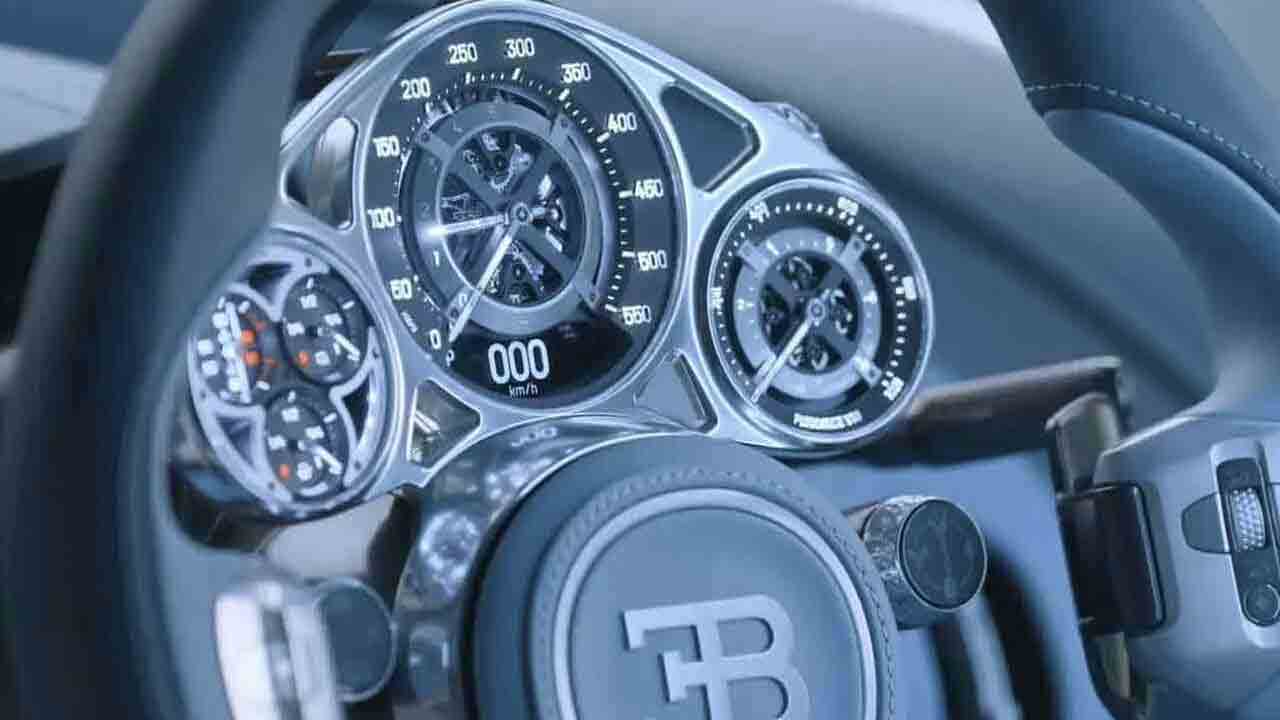
For those tired of cabins filled with screens, the new Bugatti Tourbillon offers a refreshing change with the number of physical buttons on the dashboard.
Going against the trend of many luxury car manufacturers, Bugatti kept an analog approach in the new Tourbillon. Its instrument cluster was developed in collaboration with the Swiss company Concepto, a specialist in highly complex mechanical watch movements.
The car’s name itself reinforces this concept. In French, the “tourbillon” is a watchmaking mechanism patented in 1801 to counteract timing deviations caused by gravity. Therefore, the choice was clear: no screens. Instead, there is a mechanical display designed to last for decades.

The instrument panel consists of more than 650 individual pieces and was hand-assembled by Concepto using traditional high watchmaking techniques. This process was detailed in an episode of the Bugatti A New Era documentary series.
The construction included intricate finishing methods, precisely machined components, and meticulous manual assembly. Yet perhaps the greatest technical challenge of the Tourbillon was integrating mechanical assemblies with electronic components.

Circuit boards, sensors, and LED elements had to be incorporated into an architecture originally rooted in purely mechanical watches. Standard watchmaking tools proved inadequate due to the size of the components, requiring the development of specialized manufacturing processes.
For visible surfaces, customers can choose from decorative techniques such as Clous de Paris, guilloché patterns, and tapestry textures, classic elements of traditional watch design. Materials include aventurine and various metallic finishes.

Customization is performed using physical sample parts rather than relying solely on digital renderings, allowing customers to assess the visual effect and tactile quality of materials firsthand.
Despite the mechanical focus, the system meets the demands of a modern high-performance vehicle. It combines analog dials with electronic data capture and processing, creating a solution that merges tradition with technological innovation.

Photos: Bugatti. This content was created with the help of AI and reviewed by the editorial team.
